
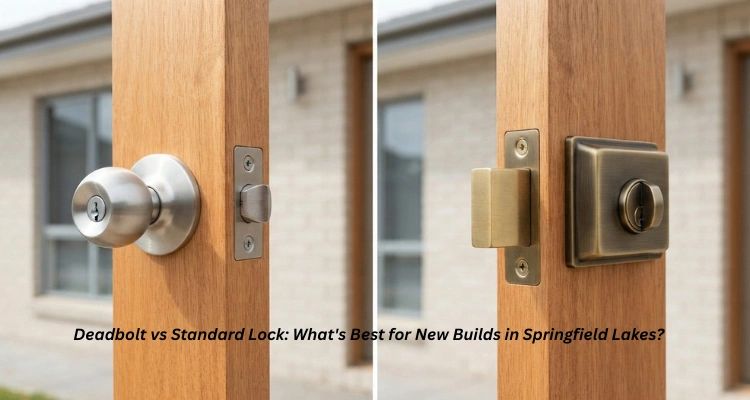
If you’re finishing off a new build in Springfield Lakes or upgrading security on a recently purchased home, you’ve probably come across the deadbolt vs standard lock decision at some point during the process. They might look similar from the outside, but the level of protection they offer is genuinely different, and that difference matters more than most new homeowners realise until it’s too late.
Builders often fit standard locks as the default option because they’re cheaper and quicker to install during construction. That doesn’t mean they’re the right long-term choice for your actual front door. Understanding the deadbolt vs standard lock difference before you settle on your final hardware can save you from having to retrofit better security later, once you’re already living in the home.
This comparison comes up often enough in new estates that it’s worth walking through properly — what each type of lock is actually designed for, where they fall short, and why the two are usually meant to work together rather than as a straight either-or choice.
What a Standard Lock Actually Offers
A standard lock, sometimes called a spring latch or key-in-knob lock, relies on a spring-loaded bolt that retracts when the door closes. It’s convenient and works fine for internal doors, but on an external entry point, it offers relatively limited resistance against forced entry. A firm kick or a simple tool can sometimes bypass a spring latch far more easily than most people expect, since the spring mechanism itself is designed for convenience rather than resistance.
These locks are perfectly reasonable for bedroom doors, bathrooms, and other internal points where security isn’t the primary concern. The issue arises when they’re used as the sole lock on a front or back door, which is unfortunately common in volume-built homes where cost efficiency during construction takes priority over long-term security planning.
Why Deadbolts Are the Stronger Choice
A deadbolt uses a solid metal bolt that extends directly into the door frame, without any spring mechanism to bypass. This makes it significantly more resistant to both forced entry and manipulation.
Deadbolts also come in graded security ratings, so you can choose a level of protection that matches your specific needs, whether that’s a standard residential grade or something higher for added peace of mind. Understanding this distinction is really the heart of the deadbolt vs standard lock question — one is built around convenience, the other around genuine resistance to force.
For any external door, a deadbolt should be considered the minimum standard, ideally paired with a standard lock rather than replacing it entirely. The combination gives you everyday convenience alongside genuine security, since the spring latch handles quick, casual use while the deadbolt provides the actual resistance when the door is properly secured for the night or while you’re away.
Pro Tip:
Look for a deadbolt with at least a one-inch throw length — anything shorter offers noticeably less resistance to forced entry.
“We see plenty of new Springfield Lakes builds with a good-looking front door let down by a basic spring lock doing all the work. It’s an easy fix before you move in.” — Locksmith Springfield Lakes
What This Means Specifically for New Builds
New estates across Springfield Lakes are often finished with builder-grade hardware chosen to meet a budget rather than maximise security. This isn’t necessarily a red flag — it’s simply how volume construction works, and builders are generally meeting the minimum standards required rather than the ideal ones a security-conscious homeowner might choose independently. But it does mean new homeowners have an opportunity, right at handover, to upgrade external door hardware before it becomes a habit to put off.
Fitting a proper deadbolt at this stage is far easier than doing it later, since the doors and frames are still new and haven’t been drilled or altered for any other hardware. It’s also a good moment to consider matching all external doors to a single key system for convenience, so you’re not carrying separate keys for the front door, back door, and any side entries.
Warning Sign:
If your front door only has a single lock and no visible deadbolt cylinder, that’s worth addressing before you’ve fully moved in.
Smart Locks and Deadbolts Aren’t Mutually Exclusive
Some new homeowners assume choosing a smart lock means giving up the security of a traditional deadbolt. In reality, many smart lock systems are built around a deadbolt mechanism, simply adding keyless entry options like codes or app access on top of the same solid bolt. The deadbolt vs standard lock comparison doesn’t really change once you introduce smart technology — a smart deadbolt is still fundamentally a deadbolt, just with an additional access method layered on top.
If keyless convenience appeals to you, it’s worth discussing smart deadbolt options rather than choosing between security and convenience. Most reputable smart lock manufacturers understand that homeowners want both, which is why the better products on the market maintain proper deadbolt-grade throw lengths and security certifications alongside their app connectivity.
It’s worth being a little cautious with budget smart locks that skip this step, since some cheaper models prioritise the smart features while quietly using a weaker bolt mechanism underneath. Checking the actual security grading of a smart deadbolt, rather than assuming “smart” automatically means “secure,” is a worthwhile few minutes of research before purchasing.
Beyond the Front Door: Other Entry Points to Consider
While the deadbolt vs standard lock conversation usually centres on the front door, it’s worth extending the same thinking to every external entry point on a new build. Sliding doors, in particular, often rely on a simple latch mechanism that offers even less resistance than a standard spring lock, since sliding doors can sometimes be lifted off their track entirely if the securing hardware is weak.
Garage entry doors — the internal door connecting a garage to the main house — are another commonly overlooked point, since homeowners tend to focus security attention on doors that face the street.
A proper security assessment at handover should account for every one of these points, not just the most visible front entrance. It’s a straightforward addition to a locksmith visit that’s already happening for the front door, and it closes gaps that would otherwise sit unaddressed for years simply because nobody thought to check.
Screen doors and security doors deserve a mention too, particularly on homes designed with an outdoor entertaining area or a covered porch. A flimsy screen door latch paired with a strong internal deadbolt still leaves an obvious weak point, since it’s often the screen door that gets forced first before an intruder even reaches the main door. Matching the security grade across every layer of a doorway, not just the innermost lock, gives a far more complete picture of your home’s actual protection.
Quick Checklist for New Build Security
Walk through this before or shortly after your handover.
Confirm every external door has a proper deadbolt, not just a spring latch
Check the deadbolt’s throw length meets at least a standard residential grade
Consider matching all external locks to one key for convenience
Ask about smart deadbolt options if keyless entry interests you
Have a locksmith assess sliding doors and garage entry points separately
Getting the Balance Right
Choosing between a standard lock and a deadbolt isn’t really an either-or decision — it’s about understanding what each one is designed for and making sure your external doors have both working together. For new builds especially, addressing this early means you’re not retrofitting security after the fact, drilling into fresh doors and frames months or years after you’ve already settled in.
The deadbolt vs standard lock decision ultimately comes down to recognising that these two hardware types solve different problems. A spring latch handles the everyday convenience of closing a door behind you; a deadbolt handles the genuine security question of whether that door can withstand someone actively trying to get through it.
Conclusion
The deadbolt vs standard lock comparison isn’t a close call once you understand what each type of hardware is actually built for. Standard locks are fine for internal doors and everyday convenience, but they were never designed to be the primary line of defence on an external entry point. A proper deadbolt closes that gap, and fitting one at handover — while your doors and frames are still fresh — is by far the easiest time to get it right.
For anyone finishing a new build or settling into a recently purchased Springfield Lakes home, this is one of the simplest security upgrades available, and it’s far cheaper to address now than to retrofit later. Getting the deadbolt vs standard lock balance right from day one means your home’s security matches the quality of everything else you’ve invested in during the build.