
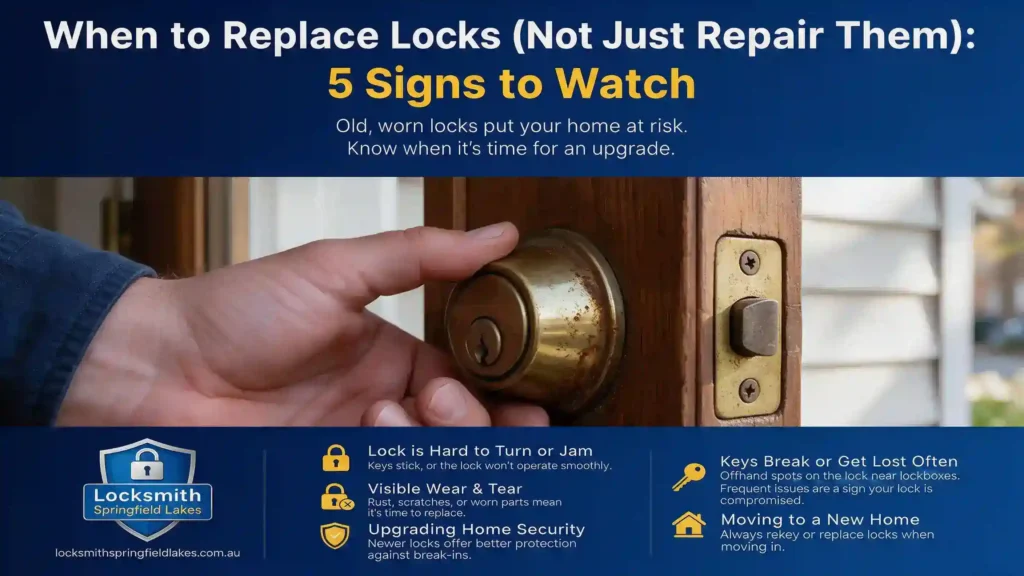
Knowing when to replace locks instead of just repairing them can save you from a much bigger security problem down the line. Most homeowners only think about their locks when they’re already standing outside, jiggling a key that won’t turn.
But locks rarely fail without warning. There are almost always small signs beforehand — a stiff turn, a wobbly handle, a key that needs a little extra encouragement. The trouble is, most people patch these issues with a quick fix and move on, not realising the lock itself has quietly reached the end of its useful life.
At Locksmith Springfield Lakes, we get called out to a lot of “quick repairs” that turn into full replacements once we actually inspect the hardware. Repairing a lock makes sense when the fault is minor — a bit of dust in the mechanism, a slightly loose screw, or a key that’s simply worn and needs recutting. But when to replace locks becomes the safer call is exactly what this guide is here to help you figure out, because the cost of guessing wrong isn’t just financial. It’s your home’s actual security on the line.
Part of what makes this decision tricky is that locks fail gradually rather than all at once. A lock doesn’t go from perfectly fine to completely broken overnight — it moves through a slow decline until one day it seizes up, or worse, someone realises it was never as secure as it looked.
5 Signs It’s Time to Replace Your Locks
Here are five signs that tell you when to replace locks rather than repair your home’s existing hardware. Some of these are purely mechanical, related to how the lock physically performs. Others are about the security of the lock itself, regardless of how smoothly it still turns.
1. The Key Sticks, Jams, or Needs a “Trick” to Turn
If you’ve started jiggling, wiggling, or applying gentle upward pressure just to get your key to turn, that’s not a quirky habit — it’s a lock telling you its internal pins are worn down. Over years of daily use, the pins and springs inside a lock cylinder wear unevenly, and eventually a key that once slid in smoothly starts catching.
A locksmith can sometimes clean and lubricate a sticky lock to buy you a little more time. Graphite powder or a proper lock lubricant can temporarily reduce friction, and for a mildly affected lock this might genuinely help for a while.
But if the wear is inside the cylinder itself — meaning the pins have deformed or the springs have lost tension — lubrication only masks the problem. It doesn’t reverse the physical wear, and the sticking will return, usually worse than before. This is one of the clearest moments to know when to replace locks rather than keep patching them.
“By the time a customer tells us their key ‘has a trick to it,’ the lock has usually been failing for months. It’s rarely a sudden problem.” — Locksmith Springfield Lakes
2. Visible Rust, Corrosion, or Discolouration
Queensland’s humidity and coastal air don’t do external locks any favours. Rust doesn’t just look unsightly — it actively eats away at the internal mechanism, making the lock weaker and less reliable with every passing month. A rusted lock is also easier to force, since corroded metal doesn’t hold up the same way fresh, properly treated hardware does.
If you can see orange staining around the keyhole, on the strike plate, or along the bolt itself, that’s corrosion working from the outside in. By the time rust is visible on the surface, it’s likely already affected components you can’t see, such as the internal springs. Repairing a rusted lock rarely solves the underlying issue, because the damage is usually deeper than what’s visible.
Warning Sign:
Rust around a deadbolt often means moisture has already reached the internal springs — replacement is the safer option here.
3. The Door Wobbles or Doesn’t Sit Flush When Locked
Sometimes the issue isn’t the lock at all — it’s how the lock interacts with the door and frame. If your door feels loose when locked, rattles in strong wind, or doesn’t sit flush against the frame, the bolt may no longer be seating properly. This can happen as a home settles over time, or after repeated forceful closing has gradually shifted the alignment between the door and its frame.
A locksmith can sometimes realign the strike plate to fix minor gaps, which is often a quick, inexpensive adjustment when the misalignment is slight. But if the deadbolt has been stressed by repeated misalignment — forced to extend at an angle it wasn’t designed for — the internal components may already be compromised. In these cases, fitting a new, correctly sized lock alongside any frame adjustment gives a far more secure result than patching the existing one.
4. You’ve Had a Break-In Attempt, Lost Keys, or a Security Scare
This one isn’t about the physical condition of the lock — it’s about who might still have access to it. If your home has experienced an attempted break-in, if keys have gone missing, or if a tenant, tradesperson, or ex-resident never returned a set, the lock’s security has effectively already been compromised, regardless of how well it still functions mechanically.
Rekeying is an option when you simply want old keys to stop working, and it’s a reasonable middle-ground solution when the lock is otherwise in good condition. But if the lock shows any signs of tampering, prying, or forced entry — even unsuccessful attempts — replacement is the safer path. A lock that’s been forced once is structurally weaker than it looks, and this is another clear case for knowing when to replace locks instead of trusting a repair or a simple rekey.
Pro Tip:
After any attempted break-in, have a locksmith inspect every external door — not just the one that was targeted.
5. Your Locks Are Simply Old and Outdated
Most standard residential locks are designed to last somewhere between seven and ten years of regular use. Beyond that, even a lock with no obvious faults is statistically more likely to fail without warning. An older lock might feel fine day to day right up until the moment it doesn’t.
Older locks also tend to lack features that have become standard in newer hardware, such as anti-pick pins, reinforced strike plates, and bump-resistant cylinders. If you genuinely can’t remember the last time your locks were replaced, or if they came with the house when you moved in years ago, age alone is a good enough reason to consider an upgrade. This is also the ideal time to look at smart lock options if keyless entry appeals to your household.
Quick Checklist: When to Replace Locks vs Repair Them
Run through these before deciding which way to go with your locks.
- Key sticks or needs extra effort to turn — Replace
- Visible rust or corrosion on the mechanism — Replace
- Door wobbles or bolt doesn’t seat properly — Inspect first, then likely Replace
- Break-in attempt, lost keys, or unreturned copies — Replace
- Lock is over seven years old with no major faults — Consider replacing proactively
- Minor stiffness with no other symptoms — Repair may be enough
Why Getting This Decision Right Actually Matters
The repair-versus-replace call has real consequences either way. Repair a lock that genuinely needed replacing, and you’re left with a false sense of security — a door that appears locked but offers far less resistance than you’d assume in an actual break-in attempt. Replace a lock unnecessarily when a simple repair would have done, and you’ve spent more than you needed to.
The five signs above exist because they’re the most reliable indicators homeowners can check for themselves before calling in a professional. None of them require special tools to notice — just a bit of attention paid to how your locks are actually performing, rather than assuming everything is fine simply because the door still closes.
Conclusion
It’s easy to assume a repair will always be the cheaper, simpler option — and sometimes it genuinely is. But a lock that’s already showing two or more of the signs above is usually past the point where a repair offers real value. In these situations, a proper inspection from a qualified locksmith tells you exactly when to replace locks and when a repair will genuinely hold up.
Homeowners across Springfield Lakes often reach out to us for exactly this reason: they’re not sure whether their lock needs a quick fix or a full swap. A short assessment usually makes the answer obvious, and it means you’re not left guessing about your home’s security. Knowing when to replace locks — rather than defaulting to a repair every time — is one of the simplest ways to keep your home genuinely secure for years to come, without overspending on hardware that didn’t need to change in the first place.